




Editor’s note: This piece was originally published on Tipping Points in July 2026. We temporarily took it down to allow for discussion, reflection, and revision of overlooked ableism and word choice brought to our attention by a reader. We know this interview was done with consent and within a trusting relationship between parent and young person. As editor, I appreciate hearing feedback directly so that I can consider and act accordingly. Your feedback by email is always welcome: annie@self-directed.org; Thank you, Annie Friday.
Small sharp fists flailing, curses flying, body spinning, Tristan Manzolini’s youngest son was a buzzsaw laying waste to the once-serene unschooling routine Manzolini had spent years constructing for her family. On the fraying outer edge of the pandemic, Manzolini was doing all she could to hold things together for her own three kids and a dozen others at the Berkshire Freedom Academy, the unschooling learning center she’d co-founded in Pittsfield, Massachusetts. Now the center was headed for closure as its building changed hands and parents grappled with their own post-COVID realities. Her marriage was on the rocks, and now there was a new challenge facing the family in the interaction they were having with their youngest child.
As someone who herself identifies as neurodivergent, Manzolini believed in her soul that flexible, personalized, Self-Directed Education could suit the needs of any kind of learner. “But I have to confess, there were moments when I was a little afraid of my own five-year-old,” she tells me in our interview for my forthcoming book, School’s Out: Why Families Are Choosing Unconventional Education (Johns Hopkins University Press).
The medical establishment was no help at first, Manzolini recalls. “Our pediatrician would just say, ‘He’s a boy,’ like that explained everything.” Finally she and her son found a neuropsychologist who did a full assessment. His diagnosis: oppositional defiant disorder (ODD) plus attention-deficit/hyperactivity disorder (ADHD). It was a challenging diagnosis for many reasons — some in the disability community object to the implication that a child is choosing to be defiant rather than reacting to unmet needs — but not an uncommon one for young people experiencing difficulties exhibited through behavior. According to the National Institutes of Health, up to 60 percent of individuals with ADHD also have ODD, which the Cleveland Clinic describes as “a pattern of uncooperative, defiant and angry behavior.”
What’s followed for Manzolini and her son has been a combination of intensive professional therapy and homegrown accommodations, including the application of consistently enforced boundaries for behavior — a tough stretch for Manzolini as an otherwise go-with-the-flow mom — and a relaxed attitude about academics through unschooling, which suits her just fine. There are no pharmaceuticals involved in her son’s treatment, at least not yet: ODD is not treatable with medication, and while ADHD famously is, Manzolini wants her son to be the one to decide if he wants to go that route. She and his psychiatrist agree it’s a choice that can be made in the future.
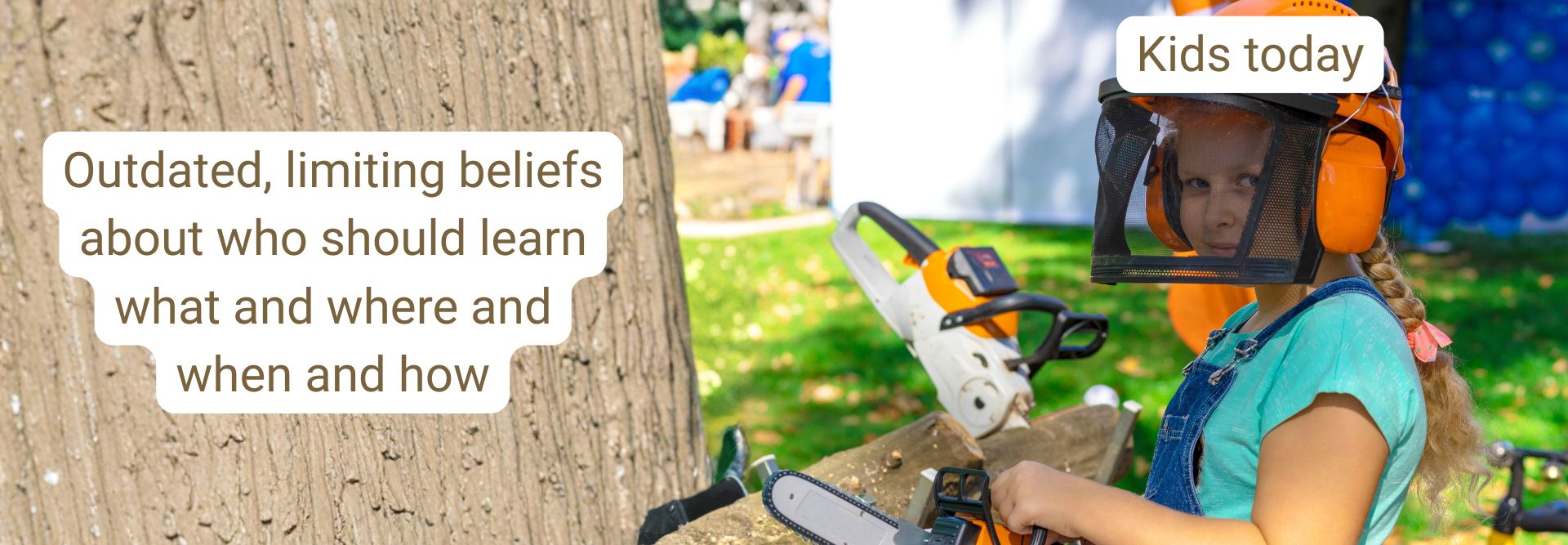
Manzolini says the changes she sees in her son as a result of his diagnosis, treatment, and flexible learning routine have already been remarkable. By 2025, at age nine, he is, more often than not, a constructive partner in the projects and outings that make up the family’s unschooling days, many of them spent outdoors in their woodsy Berkshires environs. He no longer engages in antagonizing his sister and brother, and his meltdowns are rare. Instead, he has developed a precocious and utterly calm facility with tools like wood awls, hatchets, and an actual (approved for youth use) chainsaw. “He’s a hundred percent safety first, very serious about the goggles and gloves,” Manzolini says.
All that being said, did Manzolini ever think it might have been better for everyone — the boy, his family, herself — if her son had gone to conventional public school instead, with all its mandated resources for children like him? For a moment, Manzolini is so quiet you can almost hear the click of her internal slideshow, the detonations of the past four years interspersed with real moments of progress. She says softly, “I can’t help thinking he would have been put into a special classroom, maybe even a special school.” She shakes her head, then looks up with a grin. “But it was never going to happen,” she says. “He tells me all the time how he feels about regular school: Who’d want to be inside all day long, sitting still and doing worksheets? Not him. Definitely not him.”
On multiple dimensions, Tristan Manzolini’s son is far from alone.
Across the United States, the number of students with conditions qualifying for special education has risen steadily, from 6.4 million in 2010 to 7.3 million in 2021, or 15 percent of the K–12 school population, according to a Pew Research analysis of data from the National Center for Education Statistics. As Education Week notes, that’s more than double the 3.6 million from the mid-1970s when the landmark Individuals with Disabilities Education Act (IDEA) was passed, requiring American public schools to provide such children with a free and appropriate education and funding them to do so.
Though conspiracy theories abound about the rise in the count of children with disabilities, Education Week notes that mainstream observers say it is almost certainly due to heightened parental and societal awareness, leading to more diagnoses. Though the climb in IDEA numbers paused in the 2020–21 school year while schools were closed, the pandemic actually played a dual role in increases since then. On the one hand, parents forced into up-close observation of their kids during lockdown emerged with new demands for diagnoses of learning issues they had seen with their own eyes for the first time. And on the other hand, the post-pandemic era has been marked by an echo epidemic of anxiety and depression among young people.
“Sitting down, forcing learning out of context was not something my kids enjoyed even a little bit. Instead, with unschooling I witnessed them following their interests and exploring the world around them. So many things came together,” she says, “without me having to interject at all.”
The concentration of learners with disabilities in public school is amplified outside the conventional system, including in various forms of Self-Directed Education. Recent statistics from the National Special Education Advocacy Institute suggest as many as 38 percent of homeschooled children have qualifying conditions. For many families, that’s the very reason for stepping off the conventional path. According to a 2023 Washington Post–Schar School survey, which allowed respondents to choose more than one answer, 32 percent of homeschooling families say their choice was driven by the fact of a child with special needs that they felt their local public school can’t or won’t meet, and 28 percent said they homeschooled because of a child’s psychological or behavioral issues.
For parents like Tristan Manzolini, Self-Directed Education is the only path that makes sense. Although her son with ODD may be the least typical in the family, “I don’t think a single one among us has a neurotypical brain,” Manzolini says. While she and her kids have continued to flex some of their shared routines to accommodate new needs as they emerge, they’ve found themselves moving further in the direction of unschooling rather than away from it. “I had tried doing more traditional homeschooling curriculum, but it didn’t work for us at all,” Manzolini recalls. “Sitting down, forcing learning out of context was not something my kids enjoyed even a little bit. Instead, with unschooling I witnessed them following their interests and exploring the world around them. So many things came together,” she says, “without me having to interject at all.”
Stay Informed About The Movement
If you enjoyed this article and feel called to give back to ASDE, here are ways you can support our work:
- Donate money
- Share our content with others! Click one of the buttons above to easily share on Twitter, Facebook, or email.
- Consider becoming a Contributor for Tipping Points
Tipping Points Magazine amplifies the diverse voices within the Self-Directed Education movement. The views expressed in our content belong solely to the author(s). The Alliance for Self-Directed Education disclaims responsibility for any interpretation or application of the information provided. Engage in dialogue by reaching out to the author(s) directly.