





[Editor’s note: Author Nat Nadha Vikitsreth shares an excerpt from her new book, Raising Change Agents: Practicing Social Justice in Everyday Parenting. In this excerpt, Vikisreth offers us a portal into the brain of a parent working to build social justice practices into their caregiving practice. Through the experiences of parent-child duo Estella and Kofi, this chapter explores themes that many other unschoooling and SDE parents, facilitators, and caregivers are navigating as well. As parents and caregivers to young people in this moment, it is critical to actively bring awareness to and get curious about our feelings of not being good enough, overprotecting, underperforming, over-policing, or otherwise messing up our kids. In consciously shifting from a conventional power hierarchy with our young people where adults hold all the power to a place of power-sharing and support, there seems to be an ever-fluctuating tension between purpose and control; grief and gratitude; survival and liberation. Vikitsreth invites us in through the stories of the lived experiences of Estella and Kofi to explore how these shifting tensions often show up in the practice of every day life.]
Chapter 7: Estella and Kofi’s Playbook for Being Safe, Seen, and Social in Public
“When I go into Black spaces, I have a fear that people will judge me for not being a good enough Black mom to a Black son,” said Estella in her soulful tenor. Fourteen years of raising Kofi and 55 years of surviving racism and ableism add a deep intimacy to this fear. Estella questioned whether making sure Kofi moisturized his skin and hair before going out was her fear policing him into perfection or her intention preparing him to feel belonging within a Black community. Gently rocking her post-menopausal body side to side. Left. Right. Control? Or collaborate? Left. Right. Shape? Or scaffold?
Like Estella, you might have moments when you feel this tension. Moments when you hold your breath and peek through the hand that’s covering your eyes to see if your most well-meaning parenting intention led you to police your child when you meant to prepare them. It’s hard to distinguish between the two sometimes. It’s even harder when there’s a nagging fear for your child’s safety or a gnawing worry about your child’s success running through the back of your mind. That’s why I’m inviting you, just like I did with Estella, to define what it means for your child to be survival smart and liberation smart about the issue you’re addressing. First, clarify the why. Then, strategize the how.
I asked Estella what survival smart and liberation smart meant to her in the context of teaching Kofi about taking care of his body and appearance.
Her reactive instinct to “control” and “shape” to protect Kofi was here for a reason. The reason being survival: making sure her son had everything he needed to be survival smart under white, colonial, capitalist patriarchy.
Estella glanced at the playbook diagram she printed out –perhaps a habit from homeschooling Kofi or a strategy to honor her own neurodivergent processing. Her infectious smile simmered down as her bubbling curiosity subsided into concentration. She leaned closer to her laptop screen. Her luscious wavy gray ponytail looked so effortless yet intentional –just like her wisdom:
“I often think about his future. I think about things like him having friends, friends he can trust and friends he can count on, right? Like a good friend group. I think about him having a roommate. I think about him having a partner and him having a family. So what can I [do to] start to prepare him now? And I think with him being on the spectrum, it’s another layer of preparedness that I think a lot of parents of children who are neurotypical, they take for granted that the children just learn these things. And for us, there’s a little bit more of explicit socialization around it.”
Making and keeping friends is both a survival-smart and a liberation-smart skill Estella wanted Kofi to have. For Estella, that skill starts with Kofi taking care of his changing 14-year-old body and initiating social interactions in public spaces. Looking well-groomed is not just about being well liked by his peers; it’s about being seen, safe, and social. On the one hand, being accepted into friend groups as his authentic self (when it’s safe enough) is survival smart. On the other hand, contributing to his community and cultivating belonging as an active community member is liberation smart. Clarifying your goals for being survival and liberation smart first often makes it manageable to make that two-second parenting decision when you’re triggered an intentional response instead of a reflexive reaction.
“When I go straight to ‘control’ definitely are the moments when I’m tired, when I’m stressed about things that have nothing to do with him. That is when I am way more likely to control and push and shape and police,” Estella described her reflexive reaction. Her fists clenched into shaky balls. Her breaths became shallow so she could keep up with the urgency to ask Kofi: “What are you going to wear? How does your skin look?” before each outing. These are the same feelings of tightness and urgency Estella felt when she pushed Kofi out of his comfort zone to greet folks at the park and socialize with them.
At this very moment, I also noticed my own reactivity prying my lips open. A condescending “oh well, to err is human” that many therapists like me are trained to say was about to slip out. Instead of reacting to Estella with “there, there” validation, I responded to Estella by remembering together that her reactions were done out of love for Kofi. Her reactive instinct to “control” and “shape” to protect Kofi was here for a reason. The reason being survival: making sure her son had everything he needed to be survival smart under white, colonial, capitalist patriarchy.
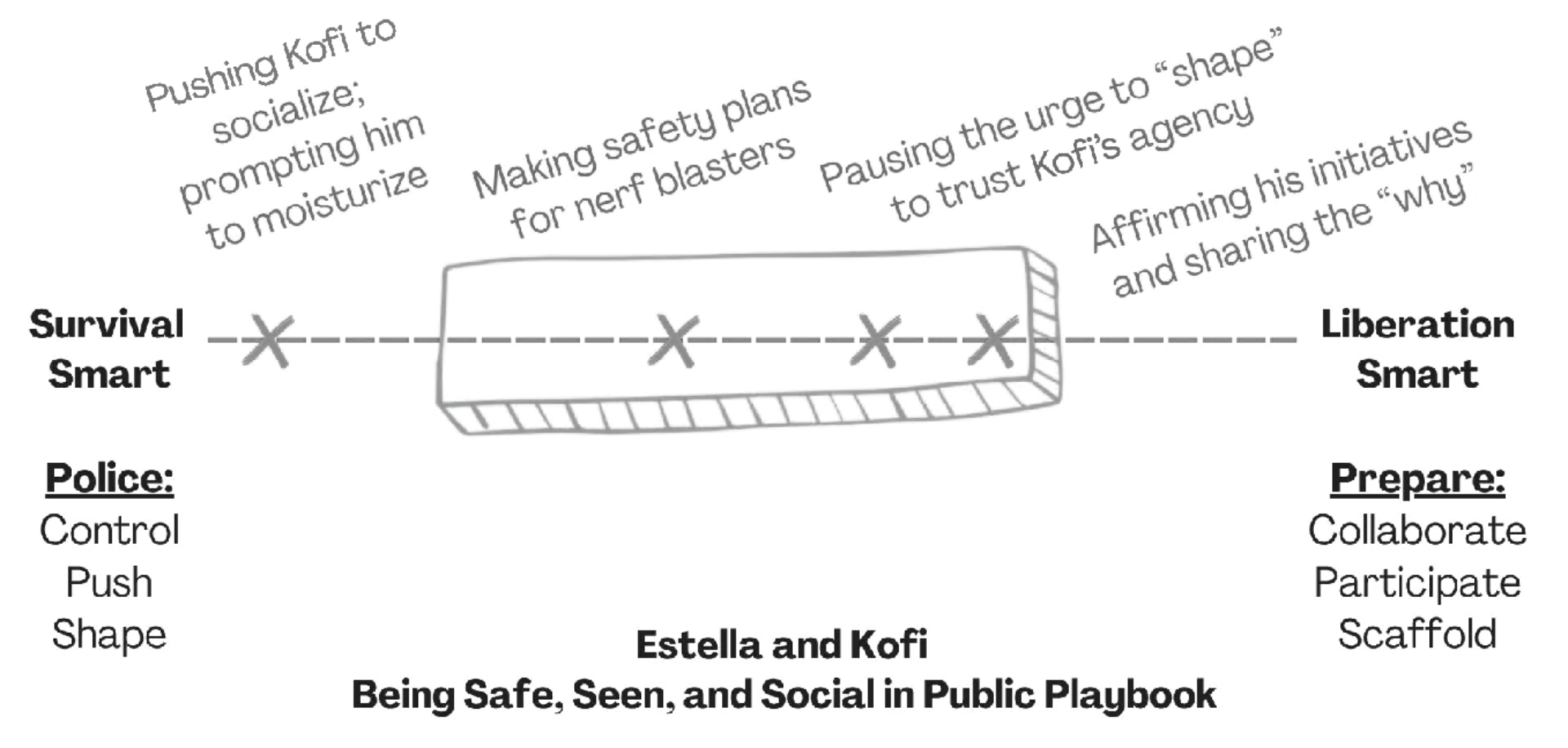
And yet, policing our children 100% of the time to protect them is not our only option. And if hearing that makes shame, guilt, and regret show up together in your mind like Beyonce, Kelly, and Michelle in their 2001 hit single, Survivor, I got you. May their wisdom –” I’m a survivor, I’m not gon’ give up, I’m not gon’ stop” –remind you that survival smart has a function and it’s not your only option. “Collaborate,” “participate,” and “scaffold” are three alternatives that you can experiment with, just like Estella and Kofi did in their “being safe, seen, and social in public” playbook.
As we review their playbook below, you’ll explore how Estella and Kofi practiced being seen and feeling belonging at a museum exhibit using “participate” instead of “control.” Then, you’ll observe how Estella course corrected “control” to “collaborate” when it came to safety concerns at Goodwill. Lastly, you’ll unpack how Estella paused her habit of hovering over Kofi’s shoulders to “shape” his behaviors during his Zoom session with a speech/language therapist. These three experiments are shown in their playbook below:
Experiment #1: Being Seen on Juneteenth
Estella and Kofi were on their way to the Arizona Historical Society. A dear friend whom Estella used to dance with invited them to a Juneteenth exhibit at the museum on a beautiful Saturday afternoon. A part of Estella was excited to have Kofi be immersed in this Black experience and truly feel that sense of belonging. And yet another part inside of her felt a familiar fear of being scrutinized, monitored, and graded as a good Black mom. Making sure Kofi’s skin didn’t look ashy and his clothes weren’t covered in their beloved dog’s hair was high on Estella’s priority list.
“As I’m walking to his room to remind him of the things he needs to do, that’s when the thought comes into my mind: ‘Is this a control moment? Is this survival smart or is this liberation smart? Where am I right now on the spectrum?’ So, for me, while I’m walking into the room to ask a question, redirect, remind, or discuss something, I’m starting to, and honestly, hold this image [of the playbook] in my mind and see ‘where am I on the spectrum?’ And it can happen in a split second,” said Estella with starry sparks in her eyes reflecting her joy at putting the playbook into action.
Their love for each other was much more powerful than Estella’s fear of being judged.
Except she didn’t check in with Kofi until they were at the museum’s parking lot about to walk into the exhibit. . .
“I look at him, his skin is beautiful, just beautiful brown skin and he had moisturized his locks and there wasn’t a lot of Jack’s hair on his button down.” Estella was on the edge of her chair brimming with delight and pinch of surprise.
Estella didn’t remind Kofi to moisturize his skin and hair for this important event. She didn’t “push” Kofi to perform self-care. She didn’t give Kofi the two choices of which shirt to wear. Kofi chose it for himself. The only choice left for Estella in the middle of that bustling parking lot was choosing to practice liberation smart with Kofi using “participate.” She participated in Kofi’s own agency by uplifting his efforts, highlighting his belonging in a Black community, and sharing with him her “why” behind wanting him to look well taken care of.
Estella: “My gosh, you took some time to take care of your
body before we left. I am grateful because we’re getting
ready to go into a space where there will be a
lot of Black people. I want to tell you right now why
that matters to me as your mom.”
Kofi: “Thank you, Mama.”
Estella: “This is a very cultural thing taking care of your hair,
taking care of your skin, moisturizing your skin is one
way that you can have pride in your appearance. That
is something that matters in the African American
community. We just have a tendency to kind of bring
a little bit more respect to how we present ourselves,
especially in public. You belong, you are part of the
Black community. And so I want you to experience
that sense of belonging. It’s a very superficial thing to
focus on like skin and like your hair. But people will
make snap judgments about you just by the way that
you look. And people looking at you and seeing your
skin so beautiful and shiny and your hair so moisturized,
people will immediately know, this is somebody
who takes pride in their appearance.”
Kofi: “Umm hmm.”
Estella: “Also, as your mom, people will judge me. If they
know that I’m your mom and we’re walking around
and your hair has dog hair in it and your skin is dry,
they’re mostly gonna look at me.”
Kofi: “They are?”
Estella: “What I’m talking to you today is a little bit about
you, but mostly it’s my own insecurity about people
perceiving me as a good Black mom. People will
judge me based on what you look like. And if people
don’t know that I’m Black, they’ll really judge me.”
This was the exact moment when Estella paused rocking her body side to side. I could hear the doubt in her mind settled. Her own wisdom from 14 years of parenting trial and error answered the question she raised earlier: “Was I policing Kofi or preparing him?” Her body rested in a gentle stillness as clarity emerged. Estella became the medicine she needed and shared: “When I thought about the playbook, it was definitely more on the liberation side. It had to do more with belonging. . . that’s a level of nuance that we’ve never talked about before.” Sharing her “why” and all its nuances was one way to help Kofi be seen as his whole self by his community and feel belonging.
Kofi suddenly entered Estella’s Zoom background with a bounce in his step and a freshly fried beignet in his hand. He hugged Estella from behind. Despite all the rapid changes in his adolescent body, his body –moisturized –snuggled perfectly against hers still. It was like an unchoreographed duet of care that would never get old for them. Kofi and his beignet left after getting my RSVP to his virtual fireball demonstration at the end of the “book talk.” “I have no words. He is just a beautiful being. And I feel so honored to have been chosen to be his mother in this lifetime.” Estella cupped her freckled cheeks between her hands.
Their love for each other was much more powerful than Estella’s fear of being judged. It was so strong that Estella would do what it took to protect Kofi, especially from potential threats of racism and police brutality.
Experiment #2: Being Safe in Public
“I wanna police it really badly though. I wanna police it,” whispered Estella who was sitting in Kofi’s making area. Estella was about to share with me what had happened when she and Kofi were at Goodwill the other day.
But the piles of art materials next to a soldering iron caught my eye. They echoed the ways Estella honored Kofi’s explorations and experiments. Kofi’s handiwork was scattered on that table. These projects were Estella’s token of love for her son’s authentic self-expression. Messy. Work in progress. Beautiful. And yet here she was talking about wanting to police Kofi...
With pride and a prickle of worry, Estella filled me in on the back story: “Kofi is a warrior and he’s a strong warrior. He has all the lightsabers and the nerf blasters and the bows and arrows and the swords and the knives. I’m not going to suppress that. We just have to figure out a way he can express his inner warrior in a safe way.”
But under that pride, there was a small pulse of unease: “How do I protect Kofi when the world sees his Black skin as a threat first and the curious inner warrior second, if at all?”
Does Estella have to police Kofi to protect him from police brutality?
Estella gave Kofi $10 for each Goodwill visit. For Estella, it was a $10 investment in Kofi exercising independence, autonomy, and financial literacy. For Kofi, it was time to refine his taste and hunt for new gems to add to his pretend play collection. Kofi has already acquired a music box, a bow and arrow set, a briefcase, and a champagne glass –among other treasurers –from Goodwill over the years. But today a pair of nerf blasters struck his fancy.
Estella and Kofi walked back to their car. Estella with a shopping tote bag in her hand; Kofi with his new toy blasters in his. It didn’t matter that the blasters were orange and blue. All Estella saw was red. In that split second, 400 years of violence against Black bodies ran through Estella’s mind: “Somebody could have thought he’s older and thought he was some Black man walking with a gun in the parking lot.” Estella gave Kofi “the look” and slowly yet firmly commanded: “Put that away, right away. There’s no room for discussion.”
Grief echoed in Estella’s heavy sigh. Her shoulders dropped, not in relaxation, but more in recognition. A painful recognition that Kofi’s childhood was robbed by the real fear of police brutality. A pang of grief that a child needed permission to exist safely and protection to play freely. And yet Estella’s intention was as loud as that echoing grief. After a deep inhale and a neck roll, Estella sat a little taller, leaned toward her camera and described that moment as survival smart. She wanted Kofi to know that when it came to safety, “you need to listen to this direction right now.” Yes, it was “control,” not “collaborate.” Yes, grief lingered. But there was no shame in sight.
I heard an unshakable trust in their relationship that’s been forged through the parenting oopses and wins of the past 14 years. Something that the oppressors can never take away from them.
Estella intentionally chose “control” to prepare Kofi for the bias, discrimination, and violence of racism. She did not frighten Kofi. She did not punish him and his inner warrior by asking him to return the blasters. This preparation is a common survival adaptation among Black families according to Dr. Angel Dunbar and her fellow researchers. They found that under oppression, Black families strategically used emotional suppression alongside emotional support to teach their children to regulate their emotions amid the ongoing violence of racism. This both/and is adaptive. The caregivers hold space for their children to feel what they feel. Then, they tone down the intensity of their children’s emotional expression. It might seem insensitive. It’s insurance against any chance that their children’s emotional explosion might bring discomfort and harm to them.
Although hindsight is 20/20, Estella’s accountability plan to collaborate with Kofi in the future gets 10, 10, 10 across the board. Before their next trip back to Goodwill, Estella would like to “collaborate” with Kofi to come up with a safety plan together. Estella imagined this collaboration might go like this: “I think in the future what we could do is we could decide when you buy a blaster from Goodwill, even before we leave the store, let’s decide, do you need a bag for this? Does mama hold it? Do you hold it in some weird way under your arm so that no one would think it was a gun? Think about how we’re walking from the store to the car? What’s gonna be our strategy so neither one of us has to worry about that anymore.”
Estella smiled at the corner of her mouth with enthusiasm about this plan she had just plotted. The spark in her eyes returned. The same spark I’m privileged to witness in many caregivers when they write their own parenting playbooks. It’s often a spark of feeling rebelliously alive and disobediently vital by exercising choice and agency in how we express care when white supremacy, colonialism, capitalism, and patriarchy conspire to squash it all away.
In each question Estella planned to ask Kofi in their new collaboration, I heard such deep trust. An unwavering trust in Kofi’s resilience. An unfolding trust in herself as a Black, bi-racial, cisgender woman and a neurodivergent single mom. More importantly, I heard an unshakable trust in their relationship that’s been forged through the parenting oopses and wins of the past 14 years. Something that the oppressors can never take away from them.
This strategy will be about teaching Kofi to be liberation smart. He will be flexing his problem-solving skills by making plans for his safety with someone he trusts. Estella added: “The majority of time for Kofi right now, it is liberation smart because he’s getting older. And because, you know, his developmental task is to be more independent and to figure out who he is away from the family unit. That is the task of adolescence. And I don’t want to hold him back in that way.”
As Estella prepared Kofi for a future free of prisons and police, she faced a wound from her past in the next experiment.
Experiment #3: Being Social with the Speech/Language Therapist
There were two conversations happening at the same time that Wednesday evening in the Arizona heat. One in the study; the other in the kitchen. One between Kofi and his new speech/ language therapist; the other between Estella and her inner critic.
In the study, the therapist began the session: “What did you practice?” “I don’t know,” Kofi replied, like most 14-year-olds would, minus the eye roll.
In the kitchen, Estella turned the stove down to simmer so she could hear Kofi in the study. But her inner critic, inner child, and inner police were harder to turn down. They all harmonized the same old survival script. The script hovered over Estella’s tongue like she was hovering over Kofi. She muttered the words under her breath: “I’m a good student. Yes, I worked on my exercises and my diaphragm breathing.” Pacing around the kitchen, Estella waved her wooden spatula coated in rich tomato broth like a passionate conductor. This conductor was actively shaping Kofi’s words and rhythms to the old tune of people pleasing. It was the same tune that the young Estella had to over-learn. Keeping peace by pleasing others has kept her safe. It also kept her small, shrinking to fit in others’ comfort. Estella paced back and forth in front of the stove. She set the spatula down next to the quarter-emptied bottle of Malbec. She paused long enough to hear a whisper of her own wisdom among other noises. “Stop.” Estella exhaled and exclaimed. “He’s okay. Let him have his way of communicating with his speech therapist. You don’t have to so actively shape and control how he presented to this therapist like the good student,” said Estella to herself, her inner critic, inner child, and inner police.
What might you notice underneath Estella’s shaping and controlling? It might have been clear as day to you and me that excelling academically and being liked by authority figures –no matter the skin color, zip code, or gender –is one way to be survival smart, especially under capitalism. Estella even said: “I want her to see him as a good student. I want her to like him and to enjoy working with him and for them to have a productive relationship.” But, in that moment, Estella knew exactly where I was going. She paused me right away. “I don’t think there is anything redeeming about that, Nat. I know that we’re trying to reframe it. I can’t find this for survival smart. I can’t find it. I don’t know what the survival smart is.”
Although the survival smart wasn’t clear to Estella, she knew with piercing clarity that her reactivity was more about her than Kofi. Her reactivity was not about what was taking place in the study right then. It was about something from her past. “I want his therapist and his tutors to know that I’m a mom who cares very much about his development and his learning, that I’m engaged. So the policing honestly was less about him. And it was just about my fears of being a bad student. It’s like the same way my mom used to braid my hair in the morning, put ribbons. . . it’s honestly like that’s a wound for me from my childhood that I’m still healing.” Estella turned to study again as if she could see vividly how her childhood wound was shaping her own child.
Sometimes we react and police our children out of real fear and worry about our children’s future safety and survival. Other times, our actions to control, push, and shape our children are triggered by an emotional wound from our past. No matter what triggers the reactivity, we want our children to master the same survival techniques we had to over-learn. Estella wanted Kofi to rehearse the same survival script of perfectionism and people pleasing to flawlessly perform as a good student. Stuck in survival, we reflexively shape our children into who we think they should be all the time, instead of nurturing who they are most of the time.
While Estella “didn’t find survival smart” for Kofi, I truly believe that she found liberation smart for herself. Estella paused and gave “the look” to her inner critic who was screaming at her (excuse me, “motivating” her to shape and control Kofi for safety). She discovered her agency in that three-second wiggle room between getting triggered and being reactive. The liberation was there in the moment when she responded instead of reacting.
Her past wasn’t haunting her. It simply was a faint reminder of what Estella had to over-learn to be safe and a familiar warning that she had better teach Kofi the same thing. Just like Janet Jackson’s songs from the 1990s, Estella knew every word from these old tracks. The lump in the back of her throat that pulled her jaw taut confirmed it. But in the very same moment, Estella knew that it was possible for her to pause the reactivity and choose to respond intentionally instead. The tape could still be playing but she could lower the volume to hear her own wisdom. The wisdom that guided her to stay back and trust Kofi to be himself. That lump in her throat felt smaller. Those inner critiques that told her to fix something that was never broken faded. The tightness in her stomach melted enough for her to feel the softness of her underbelly, which she recently embraced and called Persephone. Estella returned to her bandwidth again, where she was regulated enough to be the parent she knew she could be. Here, Estella knew it was possible for her to want freedom more than safety; dignity more than perfection; breaking the generational cycles more than being imprisoned by her past.
Their “being safe, seen, and social in public” playbook will continue to evolve. As Estella was preparing Kofi to be survival smart with racism and police brutality, she was practicing liberation smart herself, liberating herself from the fear of being judged and the reflex to people please.
We are tasked to resist the societal pressure that seeks to contort our children’s spirits and bodies to conform to the status quo of success.
“Kofi is taking ownership of how he goes through his day, how he takes care of his body without being prompted or reminded.” Estella delighted in what happened when she loosened the tight fists of control and opened her hands to collaborate with Kofi on how to be safe at Goodwill. She no longer needed to push Kofi to look presentable before going out together. Kofi already stepped in and participated in how he took care of his body. Estella’s no longer stuck in constantly shaping Kofi to be perfect, liked, and accepted by others. She could pause, step back, and be a trusting scaffold of support whenever Kofi needed it. Her agility to move out of reactivity –whether from surviving systemic oppression or her childhood emotional wounds –comes from knowing in that moment if she wanted Kofi to know how to be survival smart or liberation smart. Estella leaned closer to her computer screen. “This tool has allowed me to be more intentional and put words to more mindful ways of helping him belong, helping him stay safe. And in my mind, it helps me to be clear, like, ‘where am I on this continuum?’ because I now have this visual and I have the words for it, I feel more confident. It makes me feel more purposeful in my parenting,” Estella shared while Kofi skipped back into her Zoom background. Instead of holding beignets, this time Kofi had a lighter in one hand and a contraption he made in the other.
Estella, Kofi, and I knew right away it was time for his fireball demonstration. Kofi looked so professional in his black cotton button down, matching black trousers, and black socks. His tall frame was juxtaposed with the gleeful smile of a child. Fourteen is such a fascinating transition between childhood and adolescence. Estella reminded Kofi to check his surroundings for anything flammable. Kofi quickly pumped the handle of his homemade contraption five times while Estella and I were holding our breath. He clicked his lighter on, released the built-up pressure and rubbing alcohol fumes from his contraption, and whoosh! There it was, Kofi’s fireball and a huge grin showing delight and pride in equal measure.
Kofi’s fireball lit up a glimmer of hope for our future generations in my heart. It also reminded me of a lesson my Classical Chinese Medicine teacher taught me. Every child was born with unique skills, talents, and ancestral endowments. They came into this world with their sacred flames. Their caregivers must nurture these flames for their children to be exactly who they are. Just like each child is unique, each caregiver is a keeper of their children’s sacred flames. We are tasked to resist the societal pressure that seeks to contort our children’s spirits and bodies to conform to the status quo of success. Our role is neither to shape our children to fit the oppressors’ limited imagination, nor mold our children into someone the oppressors think “should” be. Rather, we tend to their sacred flames as they become exactly who they are and offer themselves to the world as a gift.
Stay Informed About The Movement
If you enjoyed this article and feel called to give back to ASDE, here are ways you can support our work:
- Donate money
- Share our content with others! Click one of the buttons above to easily share on Twitter, Facebook, or email.
- Consider becoming a Contributor for Tipping Points
Tipping Points Magazine amplifies the diverse voices within the Self-Directed Education movement. The views expressed in our content belong solely to the author(s). The Alliance for Self-Directed Education disclaims responsibility for any interpretation or application of the information provided. Engage in dialogue by reaching out to the author(s) directly.